Records
How AxisIQ stores your business data: record types, fields, lists, filters, CSV import and export, history and data quality.
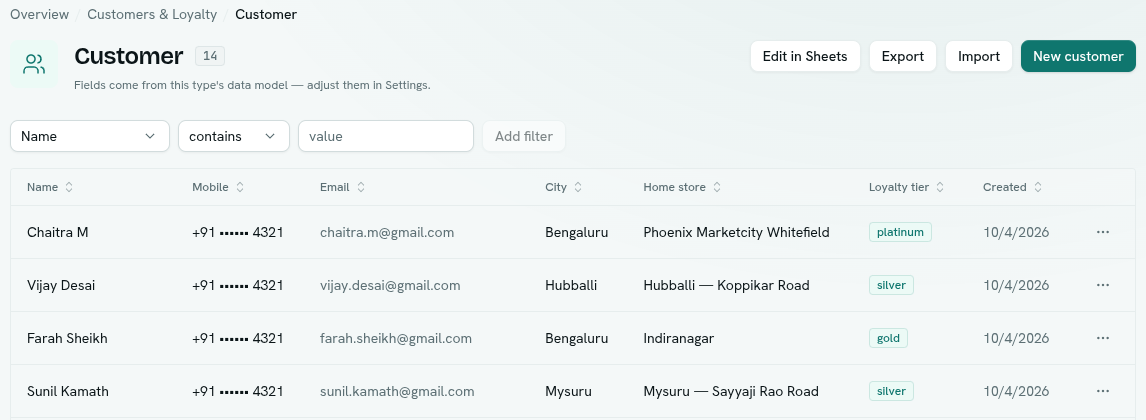
Records are the business data you keep in AxisIQ: customers, orders, products, students, invoices, or whatever your workspace tracks. Every kind of record has its own list, its own form, and its own set of fields. You work with them the same way in every app.
What you can do
- Understand how data is organised — record types, apps and menu groups. Record types and apps
- Choose the right field type — text, numbers, dates, currency, choices, links to other records. Field types
- Add and shape fields — labels, keys, defaults, required, unique. Add a field · Field rules · Edit, describe and delete fields
- Number records automatically — INV/2026/0001 style numbers. Auto-numbering
- Calculate a value from other fields — profit, totals, flags. Computed fields · Formula reference
- Create, edit and delete records — including line items and links. Create and edit records · Links and line items
- Find records — filters and sorting. Find records
- Move data in and out — Import records from CSV · Export records to CSV · Edit records in Sheets
- See who changed what — Record activity
- Check old data against today's rules — Data quality
Before you start
- Who can use it: the Business records permission on the Roles page. Can view reads records; Can add & edit also creates, updates, imports and exports; Full control also deletes records, changes fields and runs data quality checks. A role can be limited to specific record types.
- Records are part of every workspace. They cannot be switched off in Settings → Apps.
- Record types are created for you by a template or by Ask Axis. Nothing needs to be set up first.
Where to find it
Open the app that owns the data from the app launcher. In the app's left rail:
- Overview — a count for each record type and the newest records.
- Records group — one entry per record type. Click one to open its list.
- Settings — the app's data model: one tab per record type (its fields) plus a Data quality tab.
Key ideas
| Term | What it means |
|---|---|
| Record type | A kind of record, such as Customer or Invoice. It has a list and a set of fields. |
| Record | One row of a record type, such as one customer. |
| Field | One piece of information on a record, such as Email or Total. |
| Base field | A field that comes with a built-in record type. You can use it but not delete it. |
| Custom field | A field your workspace added. |
| App | A menu entry that groups record types, such as Sales or Academics. |
Related
- Ask Axis can create record types and fields for you.
- Team and permissions explains roles.
- Notifications can tell your team when records change.